← Curious Minds

Five Free Stories

The first five stories from You Are Amazing & Brilliant — Age 7. Nothing to download, nothing to sign up for. Just read.

Read aloud · ages 6–8

For the grown-up

  • 5 complete stories
  • ~8 minutes each
  • Read alone or aloud

These are the real first five stories from the Age 7 book, not extracts. No email address, no download, no app — scroll and read, on whatever you're holding.

Each one ends with a short page about what the girl in it worked out, and one small thing your reader could try. Good for bedtime, a waiting room, or a long car ride.

Hi Young Reader,

Here's something you probably already know: some days are easy, and some days really aren't.

Some days you can do the thing. Some days you can't, and everybody is watching.

This book is full of stories about girls having those days. A girl who won't put her face in the pool. A girl who pops the wrong balloon. A girl with a snail and nothing to say. A girl who waters a plant that isn't hers.

None of them are perfect. Not one of them gets it right the first time. That's the whole point.

You can read these on your own or with a grown-up. One before bed, or three in a row on a rainy day. There's no wrong way to do it.

If one of these girls sounds a little bit like you, that's not an accident. That's the good part.

You are amazing and brilliant! Now go read and enjoy the stories.

ONE

Ruby and the Three-Second Face

Brave for three seconds at a time
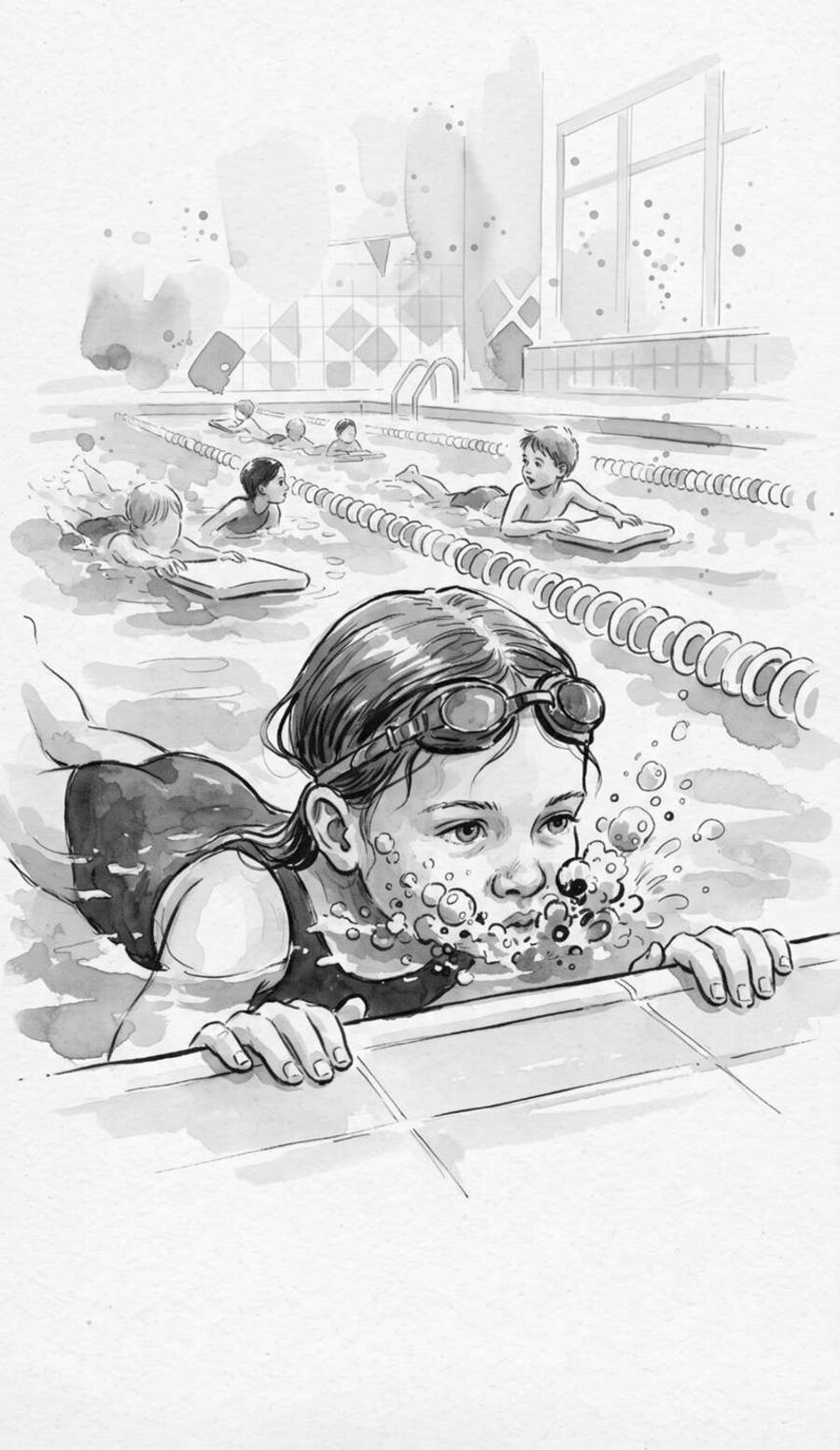
A girl in goggles blows bubbles at the edge of a swimming pool while other children swim behind her.

Eleven kids had put their faces in the water. Ruby had counted.

The pool at the Y smelled like a bleach bottle left out in the sun. Coach Dana stood in the shallow end with her whistle on a purple string, and every kid in Level Two held the wall and dunked. Bloop, up. Bloop, up. Eleven wet heads in a row, grinning like it was nothing.

Ruby held the wall with both hands and kept her face exactly where it was.

“Ruby,” said Coach Dana. “Face in.”

“I'm getting ready.”

“You've been getting ready since Tuesday.”

That was true. On Tuesday Ruby had gotten her chin wet. On Thursday she had gotten her bottom lip wet, which Coach Dana said didn't count, because lips were basically outside your face.

The water wasn't the problem. Ruby liked water. Hoses, baths, Grandma's sprinkler, the brown puddle by the mailbox. What she did not like was water going up her nose and into her ears and over her eyes all at once, in the dark, with no way to tell when it would stop.

“Okay,” said Coach Dana. “Kickboards, everybody. Ruby, you keep working on it.”

Everybody else got a kickboard. Ruby got a wall. She looked down. The water looked back, wobbly and blue, with somebody's Band-Aid floating in it.

Fine. All at once, like ripping off a sticker. Nose pinched with one hand. Eyes squeezed so tight she saw sparks. A breath so big her shoulders went up past her ears, and down she went.

Under was loud. Under was a roaring in both ears like a bathtub draining. Water went straight up her nose anyway, because it turned out you could not hold a nose all the way shut when you were also flapping your other arm around. She came up coughing and snorting with her goggles on her forehead, one strap hooked over her ear, and something in her nose that felt like a cold spoon.

The whole Level Two lane had turned around on their kickboards to watch. “Whoa,” said a boy named Deshawn. “Did you sneeze underwater?”

Ruby hung on the wall and dripped. Her left ear made a squelching sound. She tipped her head and a little waterfall came out of it onto the tile.

Next to the big pool was the baby pool, which was about as deep as a cereal bowl. A boy in a puffy swim diaper stood in the middle of it with his mom kneeling beside him.

“Ready?” said his mom. “One, two, three.”

The boy bent over, stuck just his mouth in, and blew. Bubbles fizzed up around his cheeks. He came up laughing so hard he fell over sideways, sat up, and did it again. Mouth in. Bubbles. Up. Above the nose, he wasn't even wet.

Ruby watched him do it six times. He wasn't being brave. Mouth was all he was doing.

Mouth was not nose. Mouth she could do.

She turned back to the wall. Bent forward. Put just her mouth in the water, and blew.

Bubbles. Loud ones. They tickled her chin. She counted one, two, three in her head and came up. Nothing had gone anywhere it shouldn't.

She did it again, and this time went one step lower. Chin in. Blow. Three. Up. Then she stopped, because next was nose, and nose was the whole problem.

Coach Dana walked past behind her on the deck, flip-flops slapping. “Wall's not going anywhere,” she said, and kept walking.

Ruby breathed in, put her mouth and chin under, then pushed her nose under too, and blew as hard as she could out of everything at once. Bubbles roared out of her nose like a dragon. And nothing went in. Not one drop. The air coming out was pushing the water away. She came up and stared at the water. Ha.

Mouth, chin, nose. Blow, blow, blow. Three seconds. Up. She did that four times, until the nose part stopped feeling like a dare.

Eyes were last. Eyes were the easy part now, because eyes didn't have holes in them.

Mouth. Chin. Nose. Eyes. She kept the bubbles going the whole way and counted one, two, three, and the roaring in her ears was still there but it was just a sound, and it stopped when she stood up.

Her hair was plastered flat like seaweed. Water ran off the end of her nose. “Again.”

What did you learn?

Ruby's problem wasn't being scared of water. It was trying to do everything at once. If there's something you're supposed to do that feels too big, find the smallest piece of it. Do only that piece. Count to three. Then add the next piece. You don't have to be brave for a whole minute. Three seconds is enough to start.

Your turn

  • Think of one thing you've been “getting ready” to do for a while. Say it out loud. Then say the smallest first piece of it.
  • Try just that first piece, once, today. Count to three while you do it. Then tell a grown-up what happened.

In the book, this page has lines to write on. A scrap of paper works just as well.
TWO

Biscuit Can't Do Steps

Change the game so everyone fits

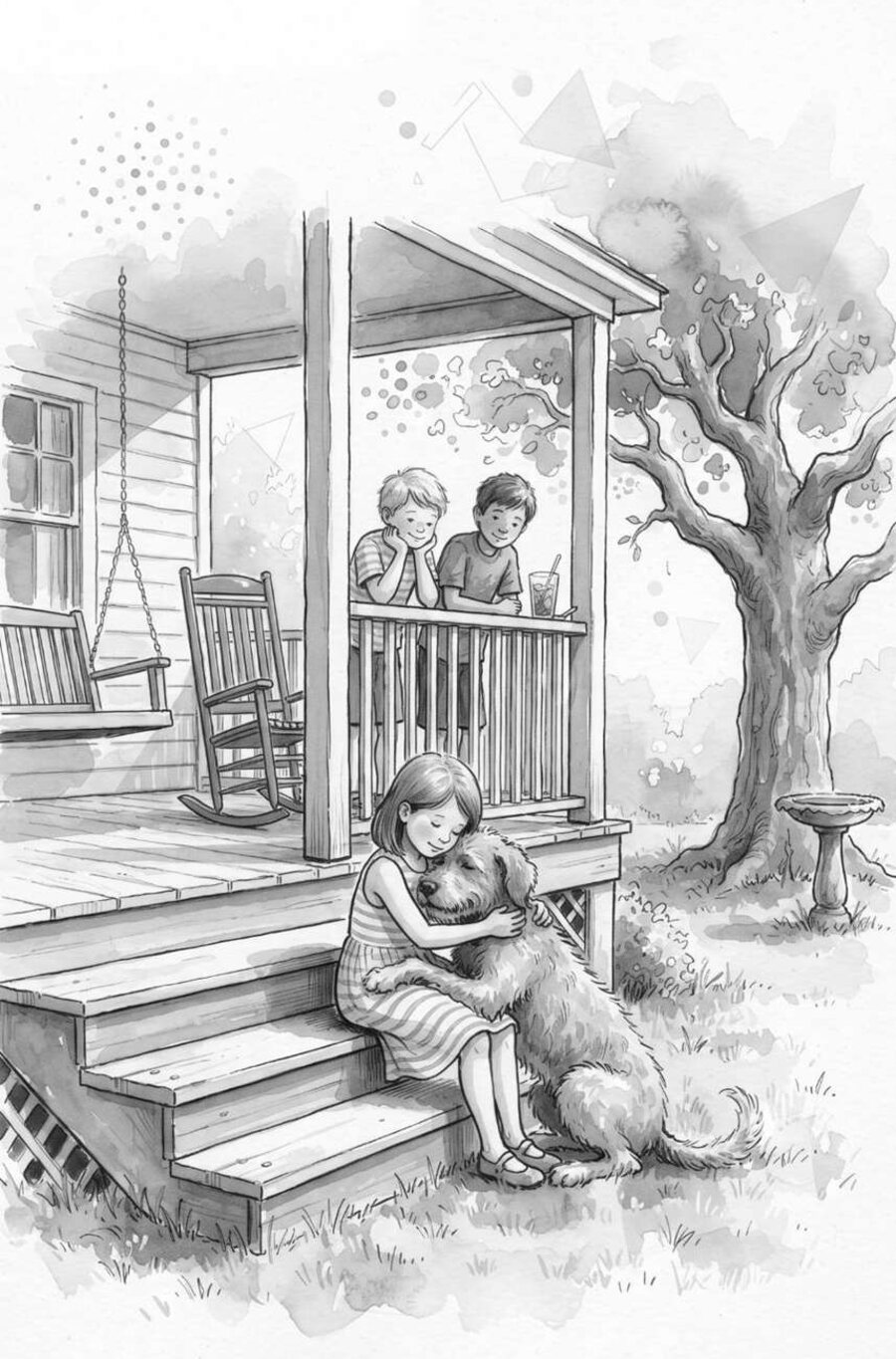
A girl sits on porch steps hugging an old dog while two children watch from the porch above.

“He's doing it again,” said Max.

Biscuit stood at the bottom of Grandpa's porch steps with his front paws on the first one and made the noise. It wasn't a bark. It was more like a squeaky door that wanted something.

Lily was at the top of the steps, being It. Max and Jonah were up there too, pressed against the railing, waiting for her to count to ten so they could run. The porch was the whole game. Wraparound, painted gray, with two doors and a swing and a fat post at every corner to swing around. Best tag anywhere.

“Ten,” said Lily, and everybody ran.

Biscuit squeaked louder.

She got Jonah by the swing and Max behind the rocking chair and it was going great until she came around the corner and Biscuit was still down there. Front paws on step one. Back legs on the grass. Tail going, but slow, like it was tired of going.

He was old. Grandpa said thirteen, which in dog was ninety-one. His muzzle had gone white and his back end didn't do what it used to. He could still walk. He just couldn't do up.

“Come on, Biscuit,” said Lily. “Come on. Up.” Biscuit looked at her and squeaked.

“You're It,” said Jonah, from very far away.

“I know.”

She went down the steps. Biscuit's whole body wagged when she got close. She wrapped both arms around his middle, which was warm and a lot rounder than it looked, and lifted.

Biscuit's back feet came off the grass. His front feet came off the step. All four of them started paddling in the air, and he let out a yelp, one sharp one, right in her ear, and she sat down hard on step two with sixty pounds of dog in her lap.

“Sorry, sorry, sorry.” She let go. He slid off onto the grass and shook himself and licked her knee, which meant they were still friends. Then he put his front paws back on step one and squeaked.

Grandpa came out the side door with a glass of iced tea and looked at them. He didn't say anything about the yelp.

“He used to beat all of you up those steps,” he said. “Beat you to the top and back down again while you were still on step three.” He went back inside.

Lily sat there. Biscuit leaned on her shin. From the porch, Max yelled that they were going to start a new game without her, and she yelled back that he'd better not.

She looked at the steps. Four of them. Biscuit couldn't do four. He couldn't do one.

The grass, though. It went all the way around the house, same as the porch did. It had the big oak with the roots you could trip on, and the birdbath, and the corner by the hose where the ground was always a little squishy.

“New rule,” Lily yelled. “Game's down here.”

“The game's the porch,” said Max.

“The game's wherever It says. I'm It. It's down here.”

Nothing happened for a second. Then Jonah thumped down the steps two at a time, and Max came after him, complaining the whole way, and Biscuit's tail started going faster than it had all afternoon.

“Base is Biscuit,” said Lily. “If you're touching Biscuit, you're safe.”

“He moves.”

“So do you.”

She counted to ten with her eyes shut and heard them scatter. When she opened them, Jonah was behind the oak, and Max was standing right next to the dog with one hand on his back, looking smug.

Lily ran at him anyway. Max ran. Biscuit walked three slow steps after Max, and Max slapped his side and said “Safe!” and then Biscuit walked toward Lily instead, and Max had to run again. It was the best kind of tag, because nobody knew where base was going to be, and neither did base.

Twenty minutes later they were flat on their backs in the squishy corner by the hose, all three of them plus one dog, breathing hard. Biscuit's head was on Jonah's stomach. Grandpa's face appeared at the kitchen window and went away again.

“Biscuit's on my team next time,” said Max, into the sky. “He's the safe spot.”

What did you learn?

Lily wanted the porch game, and she wanted Biscuit in it. She couldn't have both, so she changed the game. When somebody can't join what you're doing, you don't have to stop doing it. Look around. Is there a way to do the same thing somewhere they can reach? Sometimes the new version turns out better than the old one.

Your turn

  • Think of a game you love. Now think of a version where one more person, or one pet, could join in.
  • Next time someone can't join what you're doing, try moving the game to where they are, once. See what happens.

In the book, this page has a box to draw in. Paper and a pencil work just as well.

THREE

The Roof Keeps Falling

Try something different

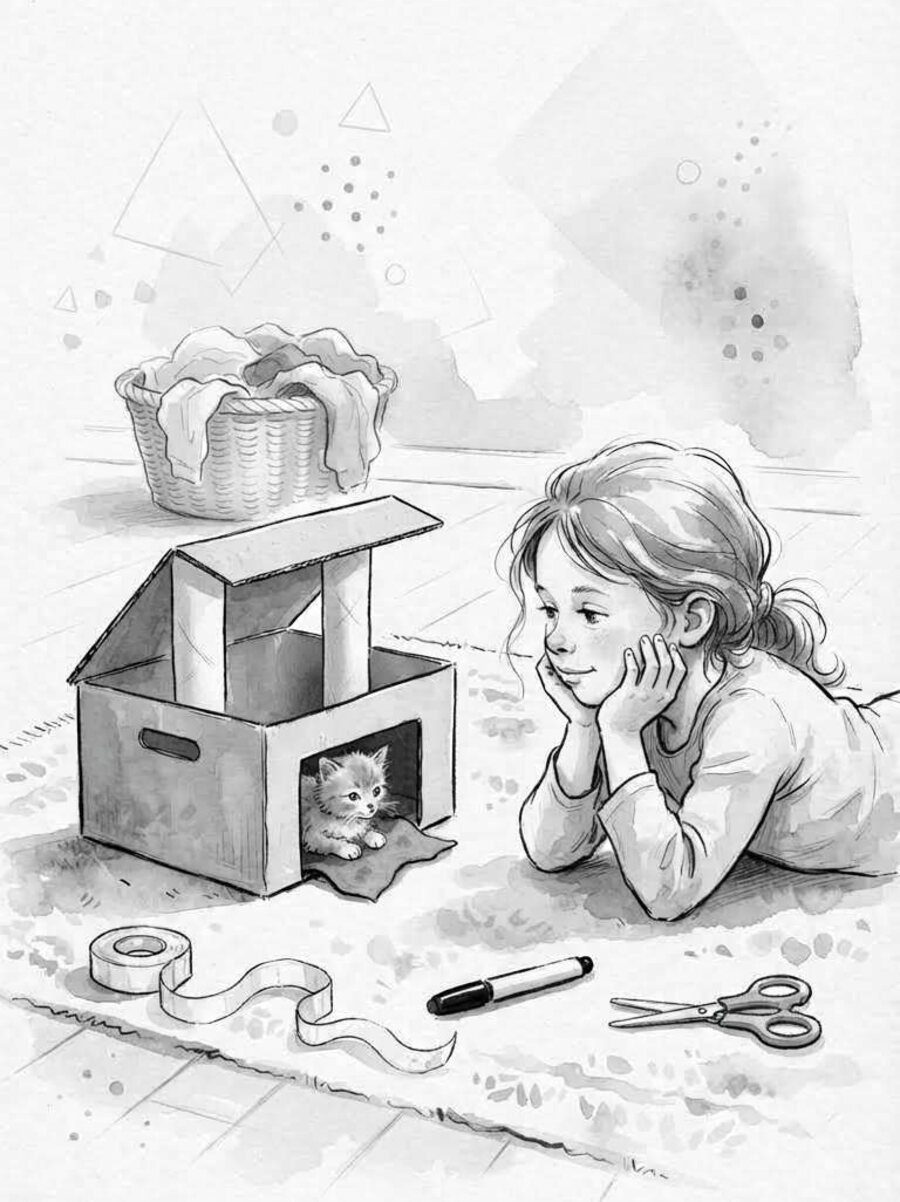
A girl lies on the floor watching a kitten sit inside a shoebox house with a cardboard roof.

Mango sat on the roof and the roof went with her.

It was a good roof. A cereal box flattened out and folded down the middle so it made a point like a real roof, and Sophie had colored shingles on it with a brown marker, each one separately, which had taken most of Saturday morning. It sat on top of the shoebox house. Then Mango came along.

The house had a door cut in the front and a window on the side and a strip of blue felt inside for a bed. It was for Mango. Everything Sophie made lately was for Mango, because Mango was new and small and orange and kept sleeping in the laundry basket, which Dad said was not a permanent solution.

Mango liked the house. That was the problem. She liked the roof most of all, and every time she stepped onto it, it sagged in the middle like a hammock and folded down into the box with the cat still on top of it, blinking.

“Off,” said Sophie. “Off. You're not supposed to be on it. You're supposed to be in it.”

Mango stayed where she was, sunk into the middle of the crushed roof, and closed her eyes. Sophie lifted her out. Four pounds of warm cat, purring, pleased with herself. Sophie put her on the rug and un-crushed the roof with both hands and tried to make the fold sharp again. It was starting to go soft along the middle. Cardboard remembered being crushed.

Tape. Obviously. She got the roll from the kitchen drawer and taped the roof to the top edges of the box, all the way around. She taped the middle fold. Then she taped over the tape. The roof crinkled when she pressed on it and made a sound like a wrapped present, but it stayed.

“There,” she said, and set Mango on top.

Mango sat. The roof went down. The tape stretched and puckered, and the whole middle of the roof went with the cat, and this time it took one wall a little bit sideways with it.

Sophie stood there with the roll in her hand, unrolling a new piece, and then stopped.

She sat at the kitchen table for a while with a bowl of apple slices and looked at nothing.

Mom was at the counter doing something with onions. “Recycling goes out tonight,” she said, not turning around. “If you've got boxes.”

Sophie ate an apple slice. She looked at the table, at the place where her bowl was, and under it, because she was slouching, at the legs. Four wooden ones. The table didn't fold in the middle when you put a bowl on it, or when Dad put a whole turkey on it, and it wasn't taped to anything. It had legs under it. Something under the middle, holding up.

Her roof had nothing under it. Just air, and a cat. She got up.

In the recycling bin by the back door, under a pizza box and a yogurt cup, there was a paper towel tube. She took it. She held it against the side of the shoebox. It was too tall by about her thumb, so she folded the end over and squashed it down until it was right.

Back in her room, she peeled all the tape off. It came away in one long sticky ribbon with pieces of roof fuzz stuck to it. Then she stood the tube up in the very middle of the box, right where the roof kept caving, and set the roof on top so the point of it rested on the tube.

The roof sat up straight for the first time since Saturday morning.

It looked funny from the front, with a tube standing in the middle of the room where a cat was supposed to sleep. Sophie thought about that. Then she moved the blue felt bed to one side of the tube and left the other side open, so it was a house with a pole in it. Some houses had poles. The fire station had one. She put Mango on the roof.

Mango sat. The roof did not go down. It bent, barely, a tiny dip where the tube wasn't, and stayed. Mango stood up, walked to the edge, looked down at the door, and jumped off. Then she walked in through the door, sniffed the tube, and sat down on the blue felt next to it. On the rug, Sophie lay on her stomach with her chin on her hands, watching.

She didn't get a roof by taping harder. She got a roof because she put something under it.

What did you learn?

Sophie's first idea was more tape. When more tape didn't work, she tried even more tape. That's what most of us do. We try the same thing, harder. If something you're making keeps breaking the same way, stop. Look at something that doesn't break. What does it have that yours doesn't? Then try that instead.

Your turn

  • Think of something you tried to fix that kept breaking. What was the broken part? Now think of one different idea, not a harder one.
  • Find something in your house that stays up on its own. A table, a shelf, a tent. Tell a grown-up what's holding it up.

In the book, this page has a box to draw in. Paper and a pencil work just as well.

FOUR

The Balloon Was Purple

Say what you did before you say sorry

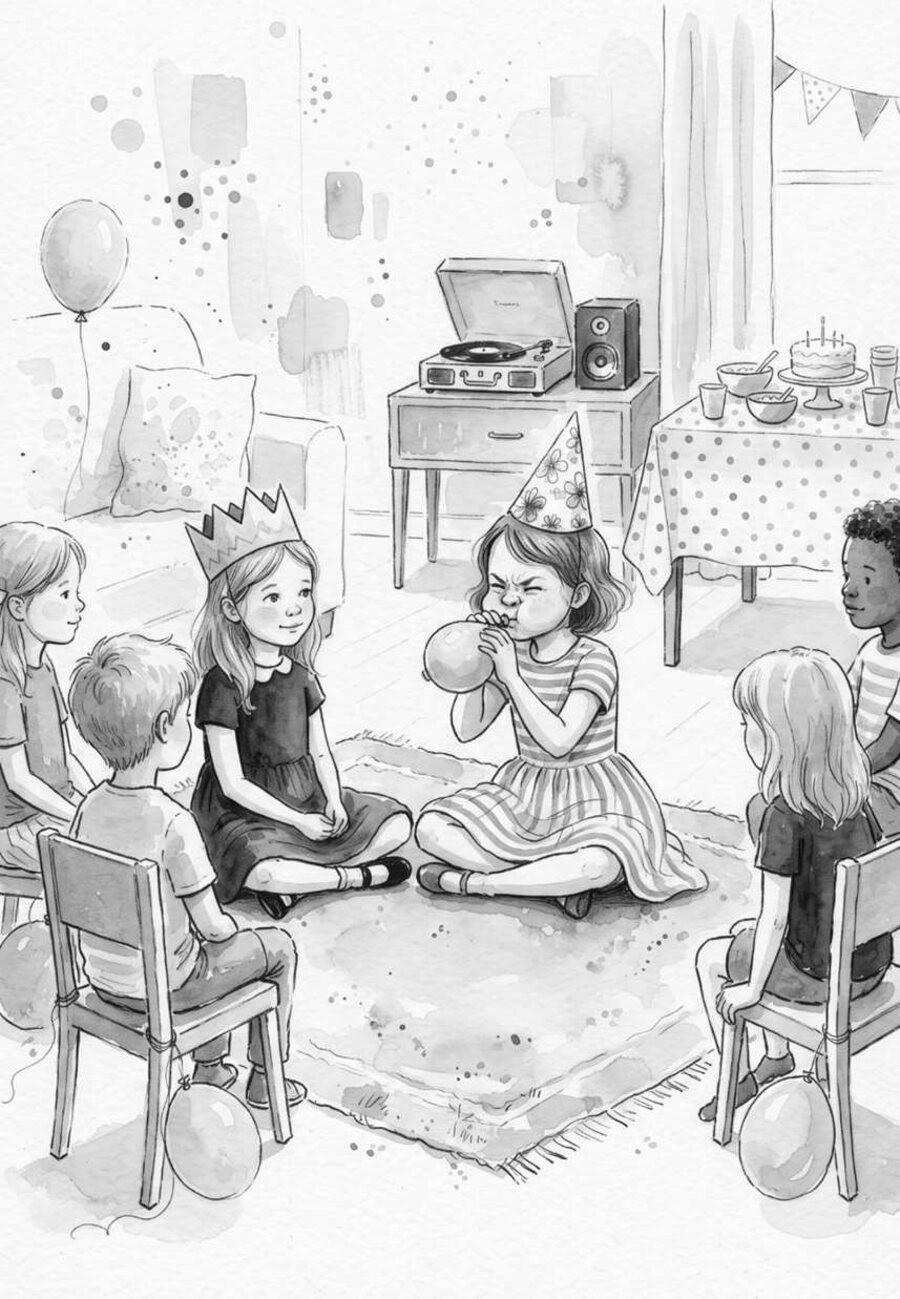
Children sit in a circle at a birthday party while one girl blows up a small balloon.

The music stopped and Ava was still standing.

Everybody else had a chair. Seven chairs, seven kids sitting on them with their knees up, and Ava in the middle of Tessa's living room with nowhere to put herself. Tessa's dad lifted the needle off the record player. They were doing the music with a record player because Tessa's dad thought that was fun.

“Ava's out!” said a boy she didn't know.

She had been right there. Right next to the yellow chair. She'd had her hand on it. Then Kayla had slid in from the other side, and now Kayla was sitting on it swinging her feet.

Ava's hands made fists without asking her. She stomped. One foot, hard, on Tessa's carpet, which made almost no noise, which made it worse. So she stomped again, and the second time her foot swung a little sideways and hit the balloon tied to the leg of the yellow chair.

Pop.

It was the purple one. The only purple one. All the others were green and white, tied in bunches to chair legs and the stair rail and the lamp, but this one had been purple, and it had been tied to the birthday chair, and it had said TESSA on it in silver marker, and now it was a purple rag on the carpet with a string.

Tessa looked at it. Then her face crumpled up and she started to cry, at her own party, in her own living room, with a paper crown on.

“I didn't,” said Ava. Everybody was looking at her. “It was already… it was going to pop anyway.”

Nobody said anything. Tessa's mom came in from the kitchen with a wet cloth and went to Tessa.

Ava went under the snack table. It was a good table for under. Long tablecloth, all the way to the floor, white with little pink dots. Nobody could see her, and she couldn't see anyone, only feet. Sneakers, sandals, Tessa's dad's socks with the hole in the toe. She sat with her back against a table leg and pulled her knees up.

“It was already going to pop,” she told the tablecloth. Quieter this time.

The tablecloth didn't argue. It also didn't help. Out there she could hear Tessa doing big wet breaths, and Tessa's mom saying, “okay, okay,” and somebody starting up the record again and then stopping it.

She thought about staying under the table for the rest of the party. Then for the rest of the year. Someone would have to slide cake under the cloth.

Her sock had a piece of popped balloon stuck to it. Purple. She peeled it off and looked at it. It was very thin and a little bit sticky, and it had half a silver S on it.

She had done that. Not the chair. Kayla hadn't. Her foot had.

Ava crawled out from under the table on the side away from everyone, stood up, and pulled her dress straight. Then she walked across the living room. It took longer than it should have. She stopped in front of Tessa's chair.

Tessa had stopped crying, but her face was still blotchy and her crown was crooked.

“I popped it,” Ava said. It came out loud. Everyone stopped talking. “Because I was mad, I got out. I kicked it. I'm sorry.”

Tessa sniffed. “It was purple.”

“I know.”

“It had my name.”

“I know.”

That was all Ava had. She stood there. Then she saw the bag of extra balloons on the side table, the flat ones, and grabbed it, and dug through until she found one that was purple. Smaller than the other kind. Round, not long.

She put it to her mouth and blew. Nothing. Blew again, harder, and her cheeks puffed out and her face went red and the balloon stayed exactly as flat as before, and a boy laughed, and she kept going, and finally it bulged out to about the size of an orange and would not go one bit bigger.

She tied it in a knot on the third try. It was lopsided. One side was fatter than the other and it had a wrinkle. She held it out.

Tessa looked at it. “That one's little.”

“It's the only purple one.”

Tessa took it. She turned it over and looked at the wrinkle. Then she reached to the side table, got a party hat, and put it on Ava's head, and tugged the elastic down under her chin so it sat straight.

“You're still out,” Tessa said. “You can be the music.”

Ava was the music. She lifted the needle and dropped it and everyone ran for chairs, and Kayla got out, and then a boy, and then Tessa, who laughed and flopped on the carpet. The boy Ava didn't know won. Nobody kicked anything.

The little balloon was taped to the back of Tessa's chair, bobbing every time someone walked past.

What did you learn?

Ava's first move was to say it wasn't her fault. Her second was to hide. Neither one fixed anything. What fixed it, mostly, was saying what she did out loud before she said sorry. Big feelings come fast. Sometimes they knock something over. When that happens, the words that help are: I did that, and I'm sorry. In that order.

Your turn

  • Think of a time a big feeling made you do something you didn't mean to do. What happened?
  • Practice the two sentences out loud, once, with a grown-up: “I did that. I'm sorry.” Then see what the grown-up says back.

In the book, this page has lines to write on. A scrap of paper works just as well.
FIVE

Rocks Are for Babies

Like what you like out loud

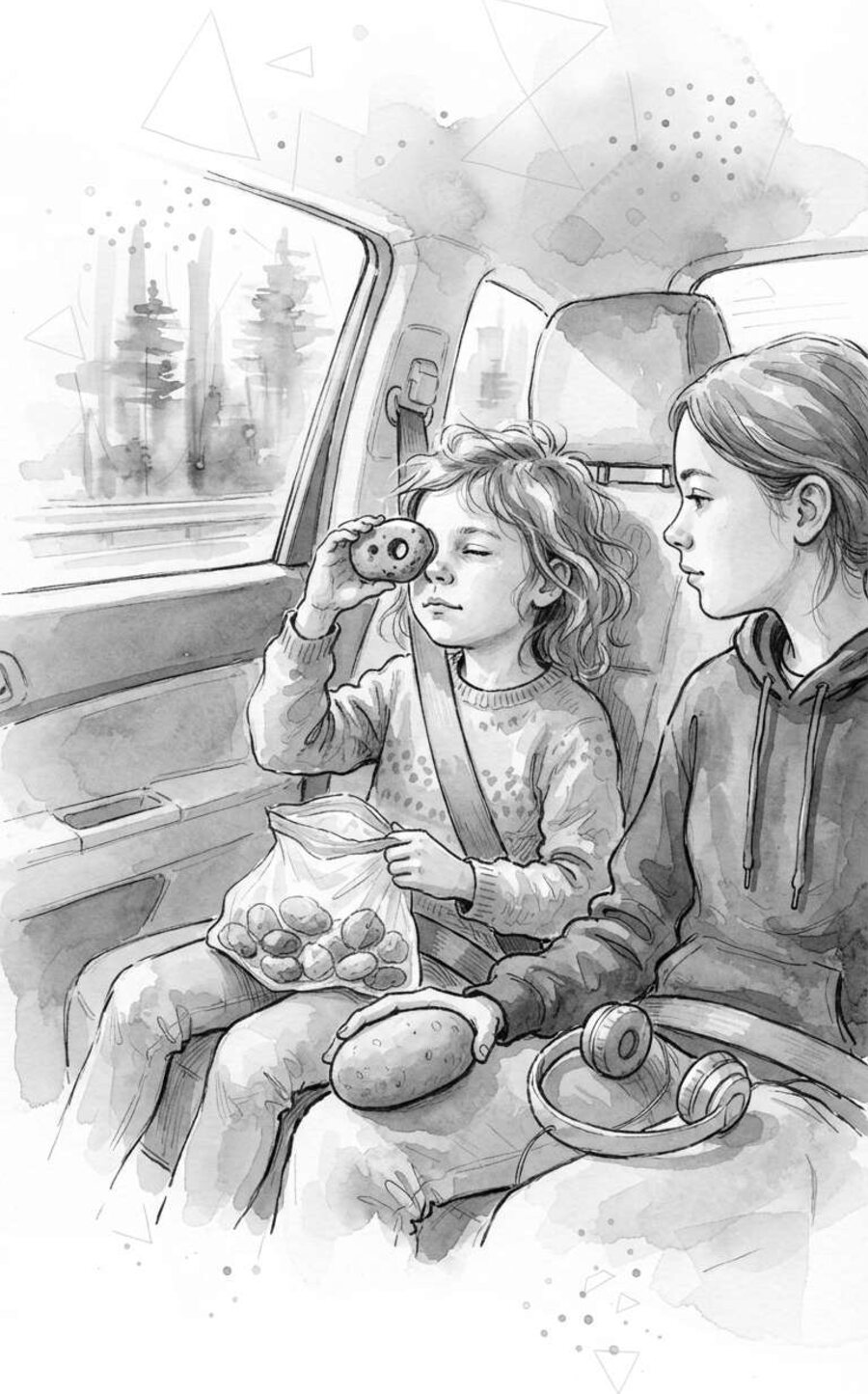
Two sisters in the back seat of a car; the younger one holds a stone up to the window to look through it.

Hannah's rocks were in a bread bag.

Nineteen of them. Too many for the bag, so it bulged in a way that made Dad say “what have you got there” from the front seat in the voice that meant he already knew. The bag went on her lap. The seatbelt went over the bag. Three hours to Aunt Jen's, and she had a plan for every one of them.

Kate's plan was headphones. Kate was ten and sat behind Dad and had recently started saying things like “whatever” and meaning it.

Twenty minutes in, Hannah opened the bag.

The first rock was the flat black one from the creek, smooth as soap. She held it up so the light came through the window onto it. Then the pink one with the sparkle. Then the one that looked exactly like a potato, which she kept mostly because of that.

“What are you doing,” said Kate, one headphone off.

“Looking at my rocks.”

“For three hours?”

“Some of them take a while.”

Kate looked at the potato rock, then at the bread bag. “Rocks are for babies,” she said, and put the headphones back on.

Hannah looked at the potato rock too. It didn't look any different than it had a second ago. It was still a rock shaped like a potato. But she put it back in the bag, and rolled the top of the bag down, and pushed the whole thing under the seat in front of her with her heel.

For the next while she did nothing.

Then Kate took her headphones off and said, “Want to play the license plate game?” and Hannah said yes so fast that Kate looked at her funny.

The license plate game was: you find a plate, you read the letters, you make a word out of the letters. Kate found G, R, T and said “great.” Hannah found B, N, L and couldn't think of anything and said “bunnel,” and Kate said that wasn't a word, and it went like that.

Hannah looked out the window. Trees. A cow. A sign for a place that sold fireworks all year. More trees. Kate was on her fourth plate. Hannah had stopped looking for plates and started looking at the cow, and then the cow was gone.

She checked the clock on the dashboard. Eleven minutes. She had been doing Kate's game for eleven minutes and it felt like the whole drive.

Her heel found the bread bag under the seat. She left it there. Kate said, “H, M, R, hammer,” and Hannah said “yeah,” and pressed her forehead on the cool window and made a smudge.

Somewhere after the fireworks sign, Hannah reached down and pulled the bag out.

Kate watched her do it and didn't say anything.

Hannah unrolled the top. Took out the flat black one. Held it up to the window, the way she'd been going to before.

“This one's from the creek behind school,” she said. “You can skip it six times. I did it. Six.”

Kate didn't answer. Hannah put the black one down on her knee and took out the next one.

“This one's got sparkles in it because of mica. That's a mineral. It comes in sheets and you can peel it if you have a fingernail, which I don't.” She held it in the light and turned it, and the sparkles ran across it like something alive.

“That one's fine,” said Kate.

Hannah took out the potato. “This one looks like a potato.”

“It really does.”

“That's the whole reason.” She put it on her other knee. Then she dug down to the bottom of the bag, past the pink one and the two gray ones and the one with the stripe, and came up with the best one, which she'd been saving.

It was gray and about the size of a plum. And it had a hole. Not a dent. A hole, all the way through, so that when she held it up to the window a little round piece of sky showed on the other side.

“This one has a hole all the way through,” she said. “I found it at the lake. You can see through it. Grandma said it takes water a thousand years to do that.”

She looked through the hole. A truck went by inside it. Then a tree. Then a tiny piece of cloud.

Kate had both headphones off now. They were in her lap, and she was leaning over as far as the seatbelt would let her.

“Give me the holey one,” Kate said. “Just for a minute.”

What did you learn?

Hannah put her rocks away because one person said one thing. Then she was bored for eleven whole minutes. You're allowed to like what you like, even if your sister doesn't. Especially then. When someone says your thing is for babies, you don't have to argue. Keep doing your thing where they can see it, and show them what's good about it.

Your turn

  • Think of one thing you like that other people don't get. Now think of one true thing about it that's interesting.
  • Show it to one person this week and tell them the interesting thing.

In the book, this page has lines to write on and a box to draw in. Paper and a pencil work just as well.

Before you go

We hope she enjoyed these. There are seven more stories in You Are Amazing & Brilliant — Age 7, along with the illustrations and the write-in pages at the back of each one.

The paperback is 50% off right now.

Reading it with her? We'd love to know what you both thought — a line or two on the Amazon page helps other parents more than anything we could write ourselves.